A Docent-Led Walk · 55 minutes · 8 stops
The Old Masters Walk
Florence to Delft, in eight pictures: how Old Master painting learned to draw, to color, and finally, to see.
Before you begin
Welcome. Over the next hour we are going to walk three hundred years in eight rooms — not as a survey, but as a story with a plot. Every "Old Master" collection risks becoming a parade of famous names hung in whatever order the walls allow. I have refused that temptation here. These eight works are sequenced the way the history actually happened: geographically, from the hill towns of Tuscany to the canals of Venice to the brick interiors of the Dutch Republic, and technically, from line to light.
We begin in Florence, in the workshop culture that rediscovered classical antiquity and taught painting to think in pure, confident contour — Botticelli's linear idealism. From there we meet Leonardo, trained in that same Florentine workshop tradition but pushing it toward something subtler: sfumato, the smoky dissolving of hard edges that his teachers never attempted. Then we travel to Rome, where the papal court assembled the greatest talents in Christendom under one roof: Michelangelo on the ceiling, Raphael on the walls, both working out what humanism looked like when translated into paint and plaster. Then we go north and east to Venice, a maritime republic with a different relationship to light and pigment than landlocked Florence and Rome — where Titian discovered that color itself, not drawing, could carry emotion and movement. This is colorito answering disegno.
Then the story crosses an ocean of taste. We leave Catholic Italy for the Protestant Dutch Republic of the seventeenth century, where there were no popes or princes to commission gods and heroes — only merchants, guilds, and burghers who wanted paintings of their own world. Vermeer and Rembrandt, our final three stops, represent the last great mutation in this lineage: painting turns inward, toward a single shaft of window light, a woman pouring milk, a girl glancing over her shoulder, a boat caught in a storm that would itself become part of the painting's own extraordinary, unfinished story.
By the time we reach the final stop, you will have watched European painting move from idealized myth to observed life, from Florentine line to Venetian color to Dutch light — the entire arc that later centuries would call, simply, the Old Masters. Let's begin where the story begins: with Botticelli, and the goddess born from the sea.
The Walk
 01
01The Birth of Venus
Sandro Botticelli · c. 1485
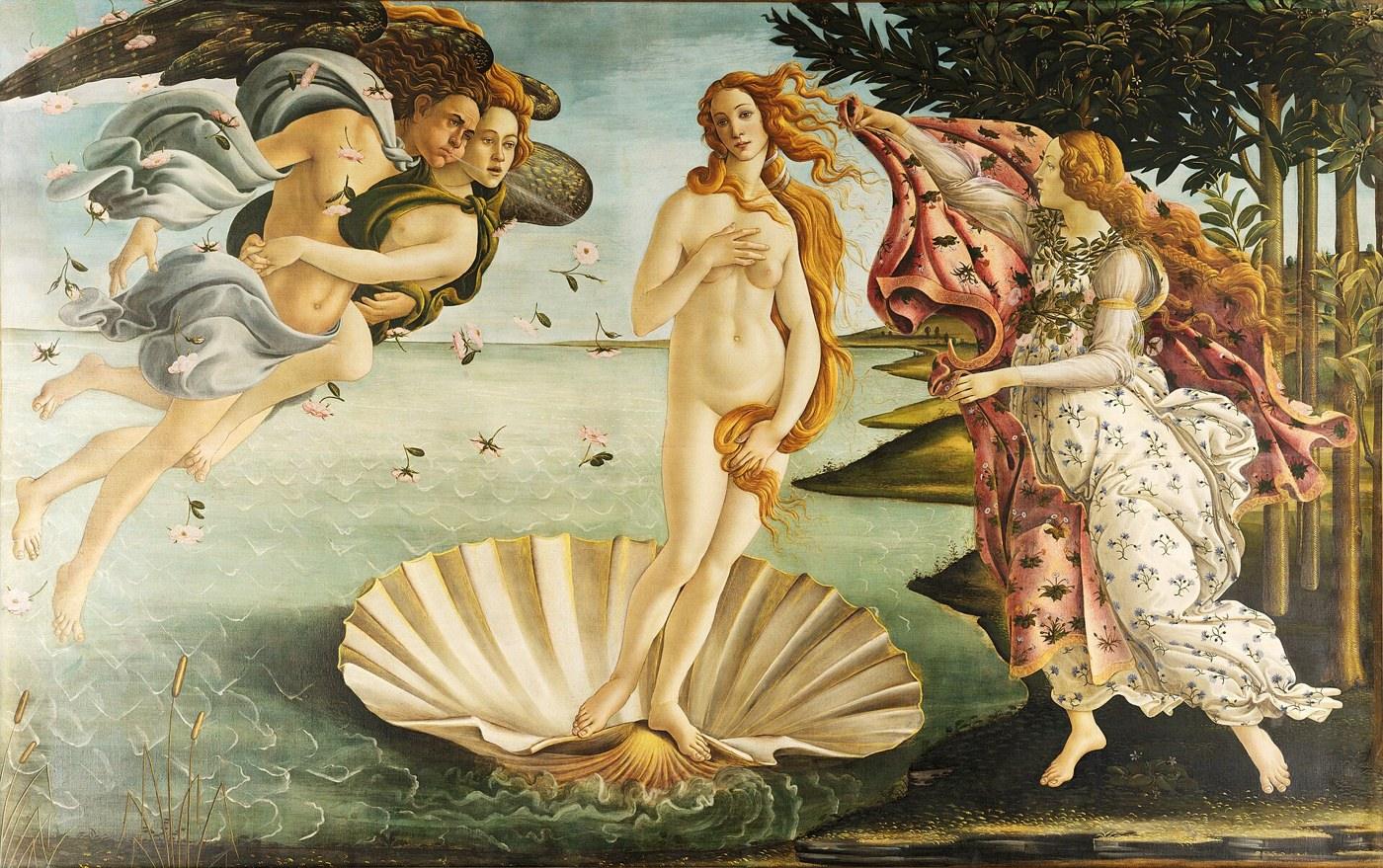
Study this work in full →We start here because everything about the Renaissance's ambitions is visible in this single canvas. Botticelli painted this for the Medici in Florence in the 1480s, and it was one of the first large-scale non-religious paintings of the female nude since antiquity — a genuinely radical act for its time. Notice the linear quality of the drawing: Venus's contour is drawn, not modeled in heavy shadow. Botticelli builds form with flowing outline and pattern rather than deep chiaroscuro, which is the hallmark of Early Renaissance Florentine style, still close to its roots in goldsmithing and manuscript illumination. Stand close and look at the hair — it moves like calligraphy, almost independent of gravity. Notice too the flatness of the sea behind her, decorative rather than atmospheric; Botticelli is not yet interested in illusionistic depth the way later painters will be. This is myth painted as poetry: Venus arriving on her shell at Cyprus, blown ashore by the Zephyrs, about to be clothed by a waiting Hora. The subject itself signals a culture newly comfortable quoting pagan antiquity to educated patrons. Keep this linear, drawing-first idiom in mind, because our next stop takes this same Florentine workshop training and pushes it somewhere Botticelli never went — toward atmosphere, mystery, and the dissolving of the very outline we just admired.
 02
02Salvator Mundi
Leonardo da Vinci · c. 1500
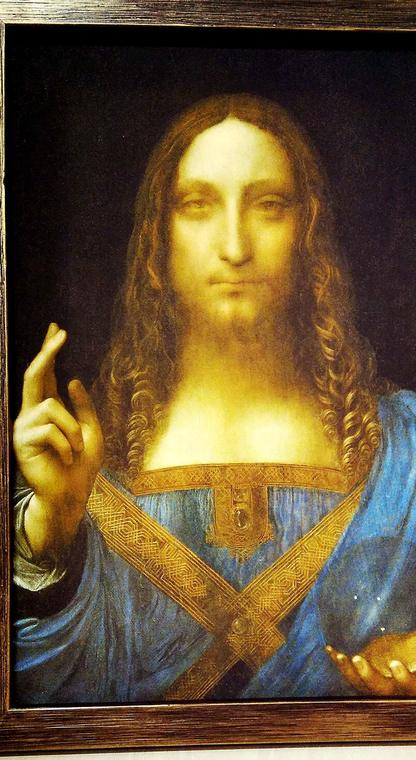
Study this work in full →This picture carries more controversy than any other stop on our walk, and that is itself worth discussing before we look at the paint. Attributed to Leonardo da Vinci or his workshop and circle, likely dating from around 1500, it shows Christ as Salvator Mundi, Savior of the World, raising his right hand in blessing while his left holds a crystal orb representing the celestial sphere. Scholars continue to debate how much of the surviving paint is autograph Leonardo and how much is workshop hand or later restoration — a debate that exploded into public view when the painting sold at auction in 2017 for 450.3 million dollars, the highest price ever paid for a work of art. Set the controversy aside for a moment and look at the technique itself, because it is unmistakably of Leonardo's world: the sfumato blending around Christ's lips and eyes, edges dissolved into soft transition rather than drawn in Botticelli's crisp contour. Notice the orb — Leonardo, ever the observer of optics, seems to have understood how a solid rock crystal sphere should refract and invert light behind it, though the orb here shows none of that expected distortion, one of the puzzles scholars cite in the attribution debate. This soft, atmospheric idiom is the Florentine tradition maturing beyond outline into mystery. Now let's cross to Rome, where two of Leonardo's rivals were solving the same Renaissance humanist problem in an entirely more public, more monumental key.
 03
03The School of Athens
Raphael · 1511
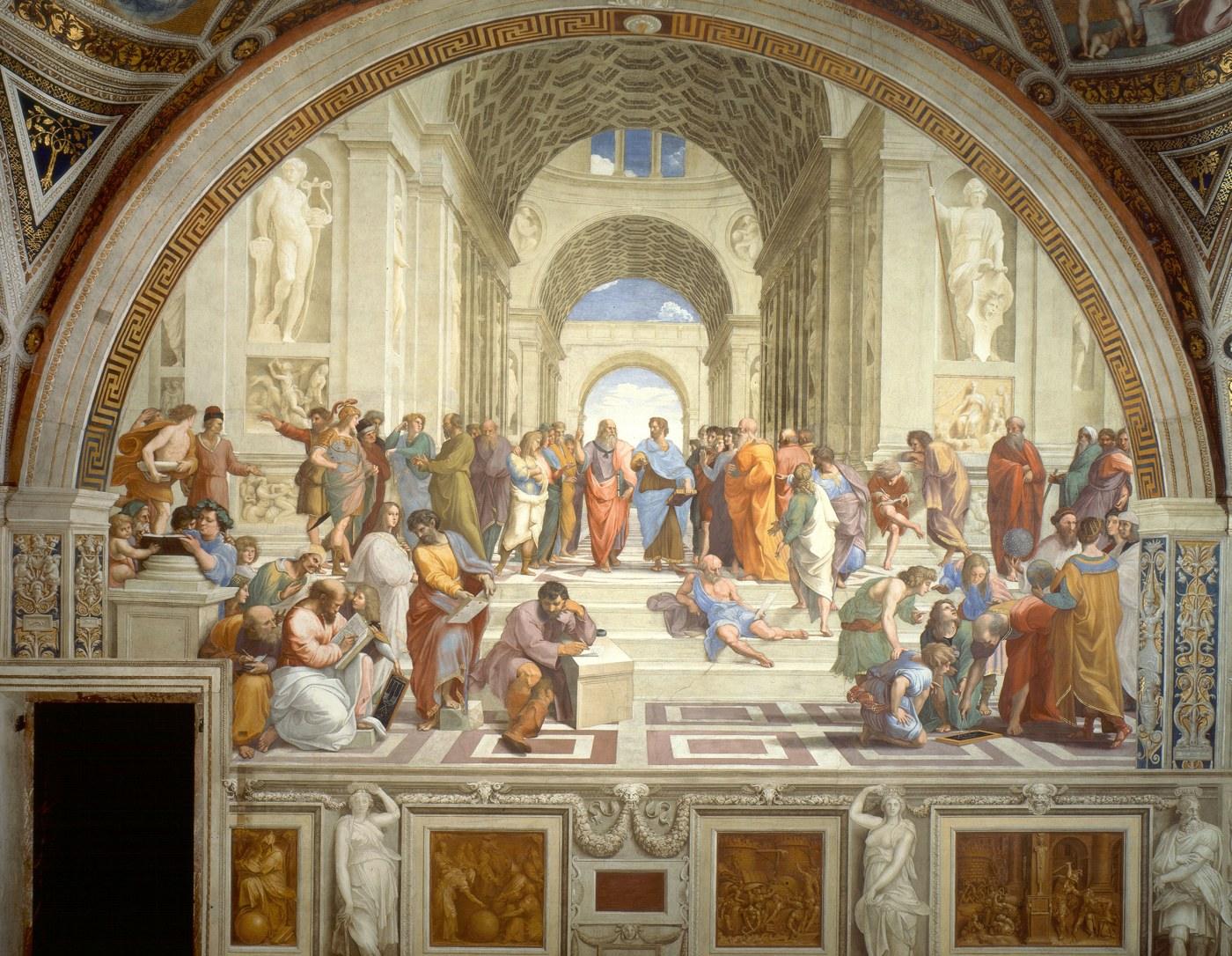
Study this work in full →Raphael painted this fresco between 1509 and 1511 for the Stanza della Segnatura, Pope Julius II's private library in the Vatican — literally the room where the papal signature was applied to documents. Look at the architecture first: those soaring coffered barrel vaults are Raphael's homage to Bramante's designs for the new St. Peter's, then under construction just steps away. This is High Renaissance humanism at its most confident — pagan Greek philosophers gathered under a Christian pope's roof, treated as if their pursuit of truth were continuous with, not opposed to, Christian revelation. Find Plato and Aristotle at the center: Plato pointing up toward his realm of ideal forms, Aristotle gesturing down toward the observable world — the entire argument of the fresco compressed into two hands. Many scholars believe the figure of Heraclitus, brooding alone on the steps, is a portrait of Michelangelo, whom Raphael could see through a window, at that very moment, painting the Sistine ceiling a few hundred yards away. Notice how assured the perspective is — every figure sits within a mathematically rational space, proof that painting had fully absorbed linear perspective as a tool for organizing complex human drama. That rivalry with Michelangelo is not incidental. Let's go see what he was doing in that other room, on his back, forty feet in the air.
 04
04The Creation of Adam
Michelangelo · 1512
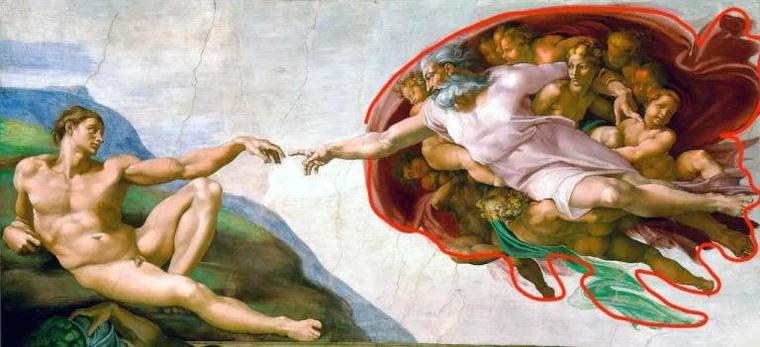
Study this work in full →Michelangelo painted the Sistine Chapel ceiling between 1508 and 1512, largely alone, on scaffolding of his own design — not flat on his back as legend has it, but standing, craning upward, an ordeal that permanently damaged his eyesight and spine. This panel, near the center of the ceiling's nine scenes from Genesis, is the most famous image in Western art for a reason: it distills an entire theology into a single gap of unfilled space. God, wrapped in a swirling mantle that many scholars have long noted resembles a cross-section of the human brain, reaches out with electric energy; Adam, newly formed from clay, reclines in languid, unfinished potential, his hand almost — not quite — touching his creator's. That negative space between the two fingertips is doing more theological and dramatic work than contact ever could. Notice the sculptural weight of every body here: Michelangelo trained as a sculptor first, and it shows in how these figures occupy volume, twisting in the exaggerated, muscular poses later called terribilità. This is the absolute peak of Florentine-Roman disegno — drawing and form as the supreme values of painting. Now we leave Rome for Venice, where a rival tradition insisted, instead, that color and paint itself, not line, could carry the deepest feeling.
 05
05Bacchus and Ariadne
Titian · 1523
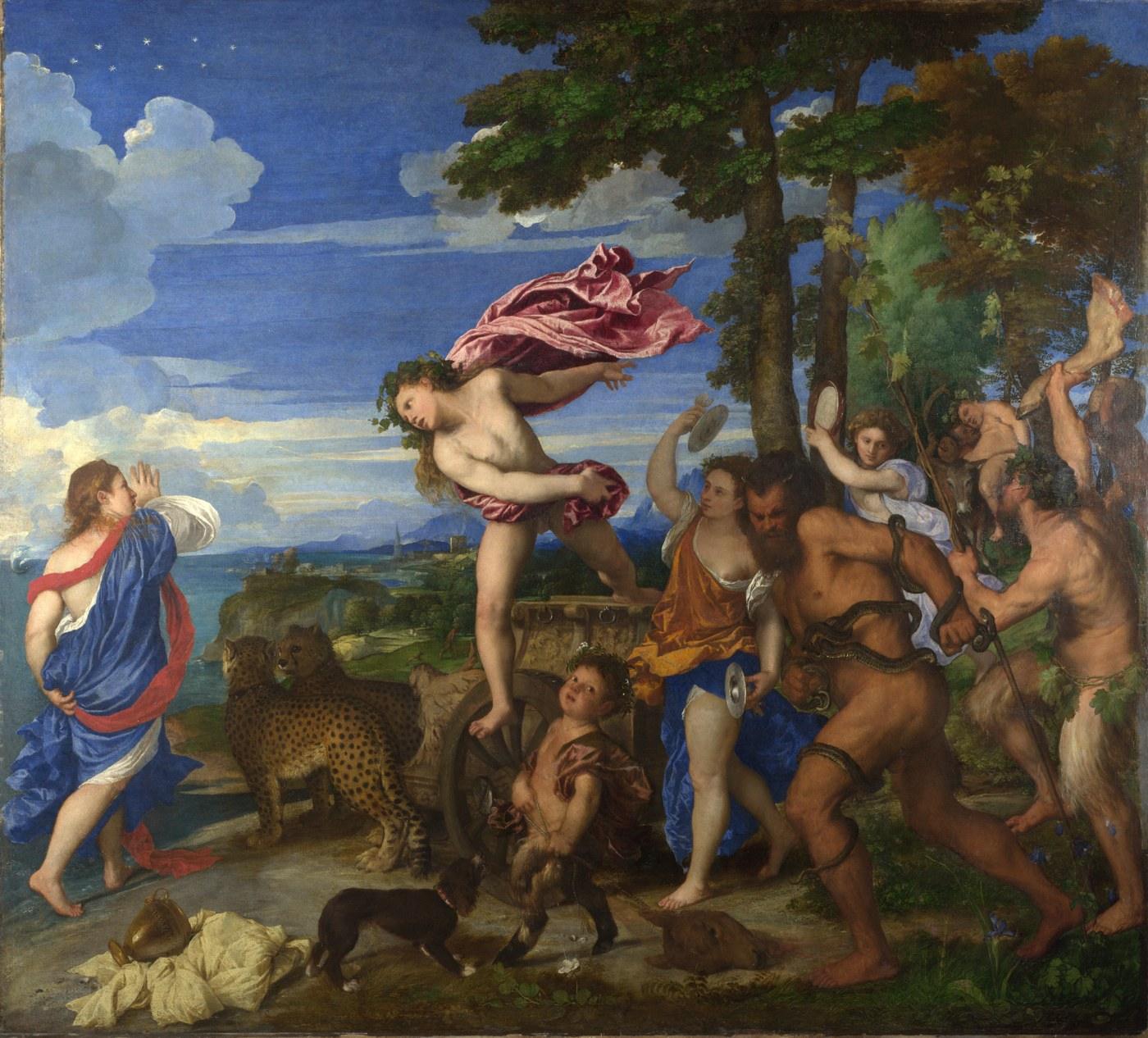
Study this work in full →Titian painted this around 1520 to 1523 for Alfonso d'Este, Duke of Ferrara, as part of a suite of mythological paintings for his private camerino d'alabastro — a small study lined with alabaster and myth. Compare this instantly, in your mind, to the Botticelli we saw first: where Florence drew Venus in cool, linear grace, Venice gives you Bacchus leaping from his chariot in a single explosive diagonal, drawn by loose, visible brushwork and saturated color rather than crisp outline. This is colorito, the Venetian conviction that paint applied richly, in color relationships, could generate movement and emotion that line alone could not. Notice the ultramarine of the sky, made from crushed lapis lazuli, one of the most expensive pigments available, deployed here without restraint because Titian's patron could afford it and wanted it seen. The subject is the moment Bacchus, god of wine, discovers Ariadne abandoned on Naxos by Theseus, whose ship you can just make out on the horizon, and falls instantly in love — the constellation above her head is the crown he will fling into the sky in her honor. Feel the sheer kinetic energy of the composition, spiraling from the leaping god down through the frenzied satyrs to Ariadne's startled turn. This is a Mediterranean, southern European climax of color and myth. Our story now crosses into an entirely different world — Protestant, mercantile, northern — where gods and heroes give way to milkmaids and window light.
 06
06The Milkmaid
Johannes Vermeer · c. 1658
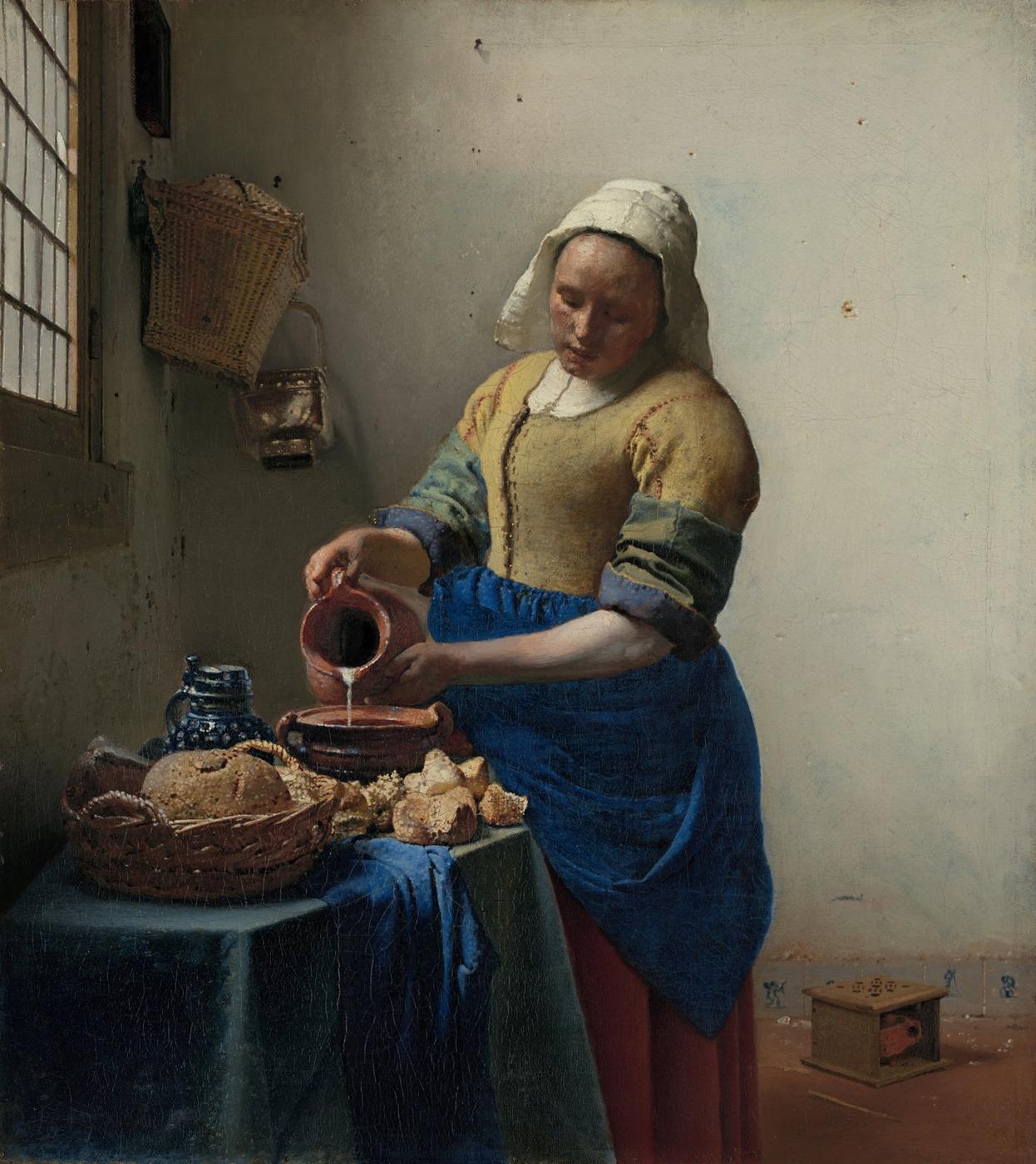
Study this work in full →We are now in the Dutch Golden Age, and everything has changed. Vermeer painted this around 1657 to 1658 in Delft, for a market of prosperous merchants and guildsmen who had no popes or dukes commissioning myths — they wanted paintings of their own tidy, godly, domestic world. Notice immediately what is absent: no gods, no philosophers, no swirling drama. Just a kitchen maid pouring milk in a bare, sunlit room. Look at the wall behind her — Vermeer renders its plaster with visible texture, nail holes, a hint of damp, an almost tactile honesty that Italian idealism never sought. Watch how the light falls from the window at left: it is the true subject of this painting, more than the maid herself, rendered with tiny dots of thick paint called pointillé that Vermeer used to suggest the sparkle of light catching bread crust or wicker. This is the Dutch inheritance of Venetian colorito, but redirected entirely away from myth and toward the ordinary — a radical form of realism that finds monumental dignity in a servant's quiet labor. Some scholars believe Vermeer used a camera obscura to help calibrate these effects of light and focus, though the debate continues. Hold this quiet, concentrated attention in mind, because our next and final two stops show you the two faces of this same Delft sensibility — one a face turned toward you, the other, a tragedy at sea.
 07
07Girl with a Pearl Earring
Johannes Vermeer · c. 1665
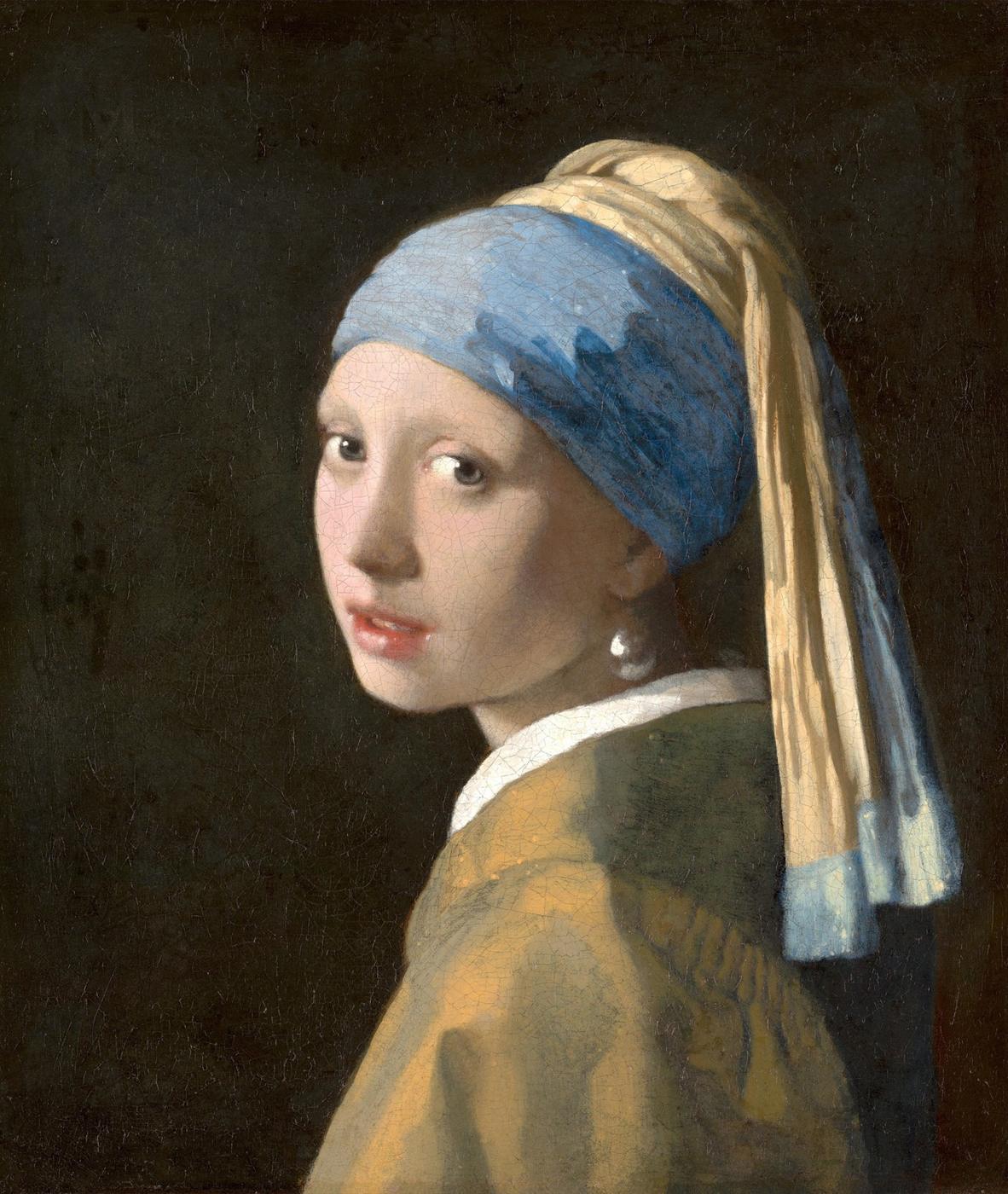
Study this work in full →Painted by Vermeer around 1665, this is not a portrait in the usual sense but what the Dutch called a tronie — a study of an imagined or anonymous face, meant to capture an expression or a type rather than to record a specific sitter's likeness for posterity. We do not know who she was, or if she existed at all outside Vermeer's imagination. Notice how little is here: no elaborate room, no symbolic objects, just a dark, unarticulated background that pushes every bit of attention onto her face and that famous turn of the head over the shoulder, lips slightly parted as if she has just been addressed. The pearl itself is barely more than two confident strokes of lead-white highlight, and yet it reads, unmistakably, as luminous and round — a small miracle of economy. The blue and yellow turban is likely an exoticizing device, evoking the East without any claim to ethnographic accuracy, a fashion for orientalist headwear in Dutch painting of this period. This intimacy — one face, one light source, one fleeting expression — is the Delft sensibility distilled to its purest form, the same patient observation of light we just saw on a kitchen wall, now turned on a human face. It has earned the nickname the Mona Lisa of the North, and standing before her, you'll understand why. Our walk ends now with her contemporary and countryman Rembrandt, in Amsterdam, and with the one painting in this room that carries its own unfinished, unresolved history.
 08
08The Storm on the Sea of Galilee
Rembrandt van Rijn · 1633
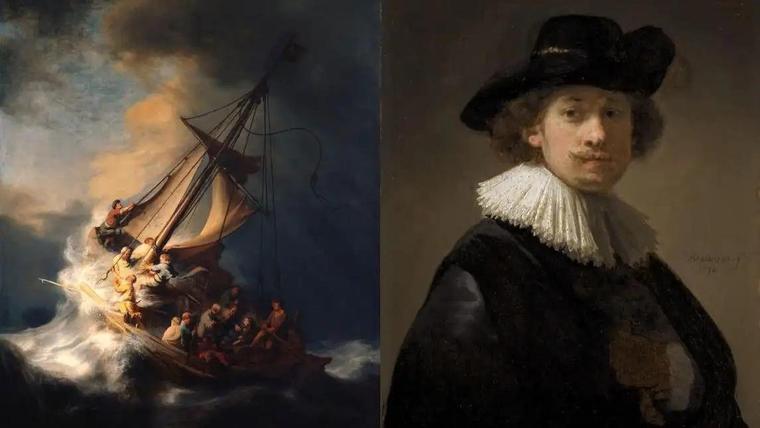
Study this work in full →We end here deliberately. Painted in Amsterdam in 1633, this is Rembrandt's only known seascape, and it shows him, still in his twenties, testing himself against Baroque drama in a way he would never attempt again. The subject is Christ calming the storm on the Sea of Galilee from the Gospel of Mark, and Rembrandt paints the boat at the exact crest of chaos: a wave crashing over the bow, rigging torn loose, disciples in visible panic. Count the figures in the boat — there are fourteen, one more than the Gospel's twelve disciples plus Christ, and many historians believe the man in the stern gripping his hat, staring directly out at us, seasick and terrified, is Rembrandt's own self-portrait, his signature this is my storm, painted into the very fabric of the drama. Look at how he handles the water: thick, agitated impasto for the foam, in sharp contrast to the smooth, dark stillness on the painting's left side where Christ has not yet spoken, uniting the whole Baroque theatrical instinct for light and dark with a very Dutch, unsentimental attention to physical texture. And here is the part of the story that has no ending: on the night of March 18, 1990, thieves disguised as police officers walked into the Isabella Stewart Gardner Museum in Boston and cut this canvas from its frame, along with a dozen other works. It has never been recovered. The frame still hangs empty in Boston today, a reminder that even the greatest paintings remain vulnerable, unfinished stories. That empty frame is, in its way, the perfect place to end our walk — from Botticelli's confident birth of a goddess to a Rembrandt whose ending is still, quite literally, missing.
Ready to bring one home?
Every stop on this walk is available as a museum-grade, hand-finished recreation — numbered, certified, and made to be inherited.