The Ultra-Luxury Atelier of ArtzFolio
Own the masterpiece
the museum guards.
Every masterpiece in human history — recreated to museum grade, on archival canvas, finished by the hand of our atelier, and numbered as a strictly limited edition. Not prints. Their equal. Made to be inherited.
The whole of art history · millions of masterworks · from ₹50,000
The Masterworks
The paintings the world knows by heart.
Each recreated to museum grade, each a separately numbered edition carrying its own Heirloom №. Choose your size, frame and finish — we make it to order.


Curated Worlds
Enter a collection.
Sixteen curated worlds — the Immortals, the Impressionists, the Old Masters, the Indian Masters, the Divine — each a private wing of the atelier.


In Motion
The atelier, in its own words.
More films on our channel
The Films
Eight films from the house of Infinity.
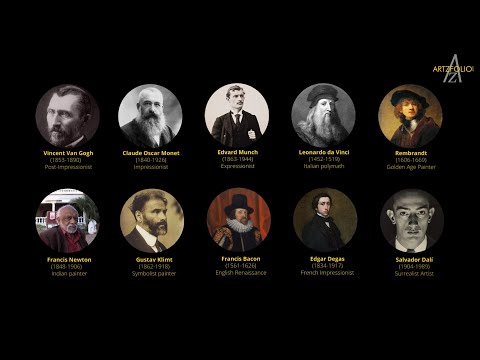


The Masters
The hands that made history.
From Van Gogh and Monet to Leonardo, Klimt, Hokusai and Raja Ravi Varma — an encyclopedia of the greatest painters who ever lived.


Facts of the Art World
Truths stranger than the canvas.
Theft, forgery, hidden anatomy, record-breaking sums — the true stories behind the masterworks, verified and footnoted. Every fact opens onto the master or the work itself.
The Mona Lisa was a relatively obscure painting until it was stolen from the Louvre in 1911 — the theft made global headlines and turned her into the most famous painting on Earth.
Louvre employee Vincenzo Peruggia hid overnight and walked out with the panel under his coat on 21 August 1911. It was recovered in Florence in December 1913, over two years later.
Discover Leonardo da VinciVan Gogh is widely believed to have sold only one painting in his lifetime — today his canvases are among the most valuable on Earth.
The Red Vineyard sold for 400 francs to painter Anna Boch in Brussels in 1890, months before his death. It now hangs in Moscow's Pushkin Museum.
Discover Vincent van GoghMichelangelo hid a strikingly accurate cross-section of the human brain inside the shroud surrounding God in The Creation of Adam.
Physician Frank Meshberger identified the anatomical detail in a 1990 study published in JAMA — the folds of drapery mirror a brain's gyri, sulci and even the brainstem.
Discover The Creation of AdamBanksy's Girl with Balloon shredded itself by remote-controlled blade seconds after selling for £1,042,000 at Sotheby's in 2018 — then resold for £18.5 million three years later.
Renamed "Love Is in the Bin", the half-shredded canvas fetched £18,582,000 at auction in October 2021, becoming Banksy's most expensive work at the time.
WikipediaRembrandt's only known seascape was stolen in 1990 and has never been found — its empty frame still hangs in the museum today.
The Storm on the Sea of Galilee was one of 13 works cut from their frames during the unsolved 1990 Isabella Stewart Gardner Museum heist in Boston, the largest unsolved art theft in history.
Discover The Storm on the Sea of GalileeMunch's The Scream has been stolen twice — in 1994 and again in 2004 — and exists in four different original versions.
The 1994 theft was foiled within months; the 2004 armed heist of the Munch Museum version wasn't solved until the painting resurfaced in 2006. Munch made two painted and two pastel versions.
Discover The ScreamLeonardo's Salvator Mundi sold for a then-record $450.3 million in 2017 — the highest price ever paid for a work of art at auction.
Christie's New York sold the painting on 15 November 2017 after a bidding war, shattering every prior auction record for art.
Discover Salvator MundiVermeer's Girl with a Pearl Earring is nicknamed the "Mona Lisa of the North" — and a 1994 restoration revealed she once had delicate eyelashes and a richer, deep-green background.
A 2018 high-resolution study, "The Girl in the Spotlight," confirmed Vermeer painted a real sitter in a real space, correcting decades of speculation that the background was abstract.
Discover Girl with a Pearl EarringScientists have mathematically analyzed the curl of Hokusai's Great Wave — it forms a near-perfect spiral, its foam breaking into smaller waves that echo the shape of the whole.
A 2009 study in the Royal Society's Notes and Records journal calculated the depicted wave was roughly 10-12 metres tall, based on the scale of the boats caught beneath it.
Discover The Great Wave off KanagawaDuring Colin Powell's 2003 UN speech on Iraq, a tapestry of Picasso's Guernica outside the Security Council was reportedly covered with a blue curtain for the cameras.
The tapestry, a gift from Nelson Rockefeller, normally greets visitors as a permanent anti-war statement; contemporary press reports said UN officials draped it so it wouldn't frame speakers discussing war.
Discover GuernicaThe Starry Night was painted while Van Gogh was a voluntary patient in an asylum — the swirling sky was partly imagined, but the view really was from his bedroom window.
Van Gogh admitted himself to the Saint-Paul-de-Mausole asylum in Saint-Rémy-de-Provence in May 1889 and painted the work around 18 June that year; the village below is an invented addition.
Discover The Starry NightBotanists have identified roughly 500 plant specimens and around 190 distinct flower species painted into the grass of Botticelli's Primavera.
At least 130 of those flowers have been matched to real species native to the Florentine countryside, making the meadow botanically accurate as well as symbolic.
Discover PrimaveraMarcel Proust called Vermeer's View of Delft "the most beautiful painting in the world" — and gave a version of that obsession to a dying character in his own novel.
In a 1921 letter, roughly eighteen months before his death, Proust wrote that ever since seeing the painting in The Hague he had known he'd seen the finest work of art in existence.
Discover View of DelftThe two wistful cherubs at the bottom of Raphael's Sistine Madonna are among the most reproduced images in art history — printed on everything from mugs to wrapping paper.
Their exact origin is debated — one legend says Raphael sketched them from real children watching him paint — but Goethe reportedly said they alone would be a masterpiece.
Discover Sistine MadonnaJacques-Louis David painted five separate versions of Napoleon Crossing the Alps — no two hang in the same country today.
Created between 1801 and 1805 for various royal patrons, the versions now reside in France, Germany, and Austria.
Discover Napoleon Crossing the AlpsKlimt's The Kiss isn't just golden in color — it's covered in genuine gold leaf, silver, and platinum, applied in a technique he adapted from Byzantine mosaics he saw in Ravenna.
Klimt used gold leaf, gold dust, and fine gold powder bound in oil, building up textured, reflective surfaces rather than painted illusions of depth.
Discover The KissDalí wrote an original poem to accompany Metamorphosis of Narcissus, then personally carried the painting to show Sigmund Freud in London in 1938.
The poem was published alongside the canvas in 1937; the Freud meeting, arranged by Stefan Zweig, was one of the only times the psychoanalyst met a Surrealist he inspired.
Discover Metamorphosis of NarcissusFrida Kahlo painted The Two Fridas — her first large-scale masterpiece — the same year she divorced Diego Rivera.
Completed in 1939 at 173.5 x 173 cm, the double self-portrait shows two versions of Frida holding hands, one with a broken heart, reflecting her split identity after the divorce (the couple remarried the following year).
Discover The Two FridasA forger fooled Hermann Göring into trading 137 looted paintings for a fake Vermeer — then had to paint a new forgery in his own defense to avoid being executed as a Nazi collaborator.
Han van Meegeren sold Christ with the Adulteress to Göring in 1942. After WWII he faced the death penalty for selling Dutch cultural heritage to the enemy, so he confessed to forgery and proved it by painting a new fake under supervision in 1945.
Discover Johannes VermeerRaphael painted himself into The School of Athens, standing shoulder to shoulder with the great philosophers of antiquity.
He's depicted beside the astronomer Ptolemy, gazing directly out at the viewer — a signature move confirmed by Renaissance biographer Giorgio Vasari.
Discover The School of AthensThe Atelier · How It’s Created
Made to order, finished by hand.
Every Infinity piece is created in our atelier on museum-grade archival materials and finished by the hand of our artists — over 30–45 days, then delivered with white-glove care. Choose the level of the hand you desire.
The Archival Edition
from ₹50,000
A museum-grade archival reproduction — pigment-rendered on hand-primed artist’s canvas through our proprietary high-fidelity process, then hand-finished and varnished so it lives as an original on your wall.
The Atelier Edition
the connoisseur’s choice
Where print meets the artist’s hand. Our master artists work brushwork, texture and glaze directly onto the archival base — until the surface breathes, and light moves across it as it does across the original.
The Master’s Hand
the heirloom
Our most involved commission. Reworked layer upon layer by our senior atelier, until the canvas carries the unmistakable touch of a human hand — a possession made to be catalogued, insured, and inherited.
The Heirloom Promise
A possession that outlives you.
Every Infinity masterwork is a strictly limited edition. Each delivered piece carries a unique Heirloom № and a signed Certificate of Authenticity with a private verification code — a possession made to be catalogued, insured and inherited.
Salvator Mundi last sold for ₹3,700 crore. Van Gogh sold a single painting in his lifetime; today his canvases command hundreds of crores. Great art is the oldest store of value there is. We make its equal — for your own walls.
Your Private Viewing Awaits
Tell us the masterpiece you were meant to own.
A curator will prepare a private proposal — the work, your dimensions, the frame, the finish, and the Heirloom № reserved in your name.